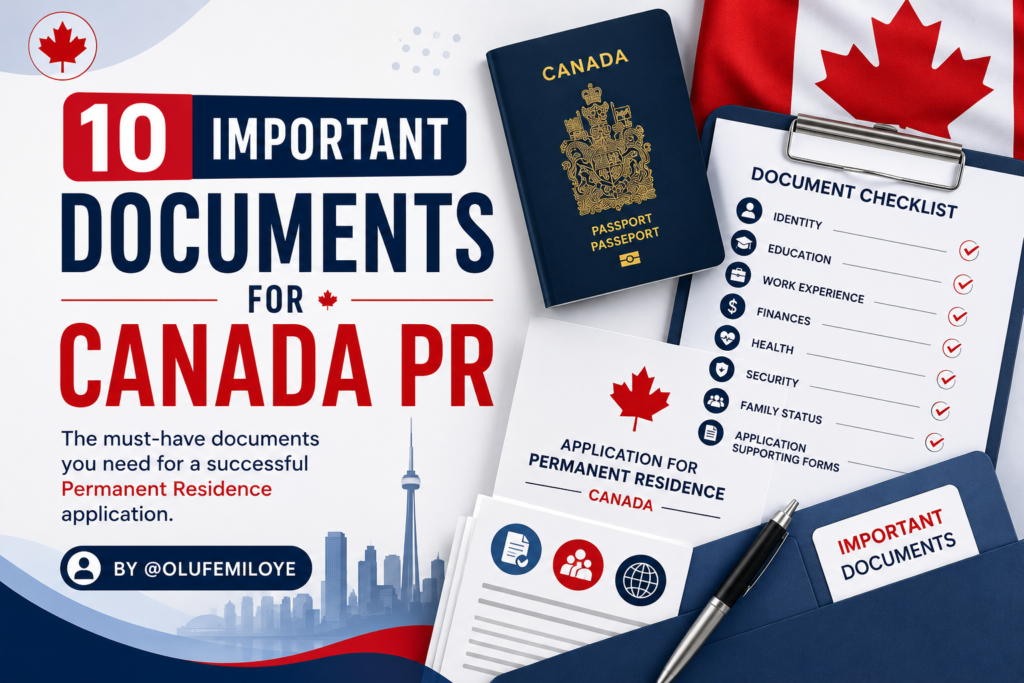
The success of your permanent residence application depends on the quality of your documents and ensuring your documentation meets the required standards.
Missing or incorrect documents are among the most common reasons for delays, additional document requests, application refusals, or visa bans in Canada. If you missed it, you can check our previous post on the top 20 permanent residence refusal reasons in Canada here.
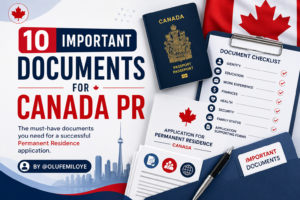
These 10 documents are very important when applying for permanent residence in Canada. Before submitting your application, double-check that every document is current, complete, and consistent with the information in your application.
Read. Bookmark. Share with others.
1) Valid Travel Document (Passport):
To confirm your identity and the identity of other accompanying family members, a clear and legible copy of the biographical data page of a passport or travel document must be provided.
Ensure your travel document remains valid throughout the application process.
2) Language Test Results:
To confirm your identity and the identity of other accompanying family members, a clear and legible copy of the biographical data page of a passport or travel document must be provided.
Approved tests such as IELTS General, CELPIP General, PTE Core, TEF Canada, or TCF Canada are used to prove your English or French proficiency and determine your immigration points. Write your language test and pass very well.
Some permanent residence applications (such as Family Class – Spousal Sponsorship applications) do not require language test results.
Checkout the helpful resources you can use to prepare for your language tests here.
3) Educational Credential Assessment (ECA):
If you are claiming points for education completed outside Canada, an ECA confirms that your credentials meet Canadian educational standards.
Start your ECA as soon as possible. Due to delays in processing, sending, or confirming transcripts by some schools, some ECA processes may take longer than expected.
You do not need ECAs for Diplomas/Degrees completed at a Designated Learning Institution (school) in Canada.
Additionally, some First degrees will give you the equivalent of points for Master’s Degrees. They are designated degrees like Law, Pharmacy, Medicine. Check the details and how to maximized these points here.
4) Proof of Work Experience:
Reference letters, employment contracts, pay slips, and tax documents help demonstrate that you meet the skilled work experience requirements.
Prove beyond reasonable doubt that you performed the duties of the job and duly received payments.
Ensure your employment reference letter does not omit key details, select the correct NOC, and provide any useful additional evidence.
5) Police Clearance Certificate:
This is required for every country where you have lived for at least 6 months since the age of 18. It is to show you do not have a serious criminal record
Some countries put expiry dates on their police certificates. Ensure your police certificate was issued after the last time you stayed there
Visit the IRCC website for country-specific information and for details on those who may use expired Police Certificates.
6) Medical Examination Report:
An immigration medical exam completed by an approved panel physician is required for the applicant and family members. This confirms that you meet Canada’s health requirements.
Medical Exams are generally valid for one-year, but certain applicants inside Canada can reuse a previous Immigration Medical Exam completed within the last 5 years. Check the IRCC website for details of this exemption.
7) Proof of Funds:
Your Proof of Funds (POF) is an important part of your PR application. Double-check the POF threshold you need based on the number of people in your application.
Key things to note are the exchange rate, source of the funds, your 6-month bank statement (even if you got a gift deed), etc.
If you are a CEC candidate in the Express Entry system, you don’t need POF.
Details available here.
8) Digital Photographs:
Recent photographs that meet IRCC’s specifications are required for your PR application and, if approved, for your PR card.
Each accompanying family member will also provide their digital photographs.
Ensure your photographs reflect your current appearance (taken within the past twelve (12) months).
Details available here.
9) Civil Status Documents:
Documents such as your birth certificate, marriage certificate, divorce certificate, or adoption records are essential when establishing your family relationships and legal status.
Ensure these documents are official, government-issued documents or cetificates.
10) Letter of Explanation:
If there are grey areas to clear up in your application, don’t forget to write and submit that letter of explanation.
The client information section of your application is where to add any additional document or your letter of explanation.
One final thing to note…..
Be Permanent Residence Ready, Always…
Prepare ahead and be permanent residence ready. Like we always say, seize the opportunity of a lifetime in the lifetime of the opportunity.
Need professional support for your permanent residence application before or after submitting your? Get in touch with the licensed consultants at Specter Immigration. You can reach out by:
E-mail: specterimmigration@gmail.com
Phone: +1-431-293-8299 (Call or WhatsApp)
We are rooting for the success of your application!
If you have questions on Career & Personal Development, Global Opportunities, Personal Finance, or Building a Personal Brand, and want to reach out to us, check what we have here.
DISCLAIMER: The posts and information on this website are not legal advice. We are not Canadian Immigration Consultants and do NOT provide Canadian Visa Application Services. For any authorized Canadian Immigration information, services, or support, please check the Government of Canada website at www.canada.ca/immigration
© Olu of Canada