The first half of 2026 is already gone. We are now in the second half. How are things going with your Canadian immigration plans?
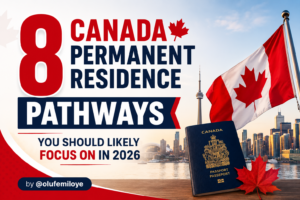
I don’t want you to spend time on immigration pathways that won’t help you reach your goals. So, without wasting too much time, these are the 8 permanent residence pathways to focus on in the second half of 2026.
Read. Bookmark. Share with others.
1) Express Entry – Occupation Category:
In February 2026, Canada released the list of sectors and occupations to be prioritized for permanent residence through the Express Entry pathway.
Positioning yourself by getting the required work experience in one of the occupations in the selected sectors will increase your chances of getting permanent residence in Canada.
In the first half of 2026, thousands of candidates were invited in the occupation categories of Healthcare & Social Services, Trades, Physicians, and Senior Managers.
Details available here and here.
2) Express Entry – French Category:
For those who are unable to obtain the required work experience in one of the above occupational categories, the French Express Entry category is your next option. For this, your work experience can remain in your profession (even if it is not one of the priority categories).
In the French language category, eligible candidates are invited for their French language ability and must have up to a CLB 7 in the TEF or TCF French language test.
In addition to the language test, you also need at least one year of work experience (within the last 10 years) to create your Express Entry profile.
In the first half of 2026, a total of 6 French language draws were done, and 30,500 French-speaking candidates were invited to apply for permanent residence in Canada.
Details available here and here.
3) Express Entry – Canadian Experience Class Category:
The Canadian Experience Class (CEC) of Express Entry is for skilled workers who have Canadian work experience and want to become permanent residents.
To be eligible, you must have at least one year of eligible work experience in Canada, gained in the 3 years before you apply.
Many people don’t know you can remain eligible for CEC even if you are now living outside Canada.
Details available here and here.
4) Provincial Nominee Programs:
There are 10 provinces and 3 territories in Canada, and you will find different types of nomination programs in almost all of them
What you need to be nominated for permanent residence in a province depends on the precise province and the nomination stream you are applying for. Do extensive research on this.
Some of the things that may position you well for a nomination are work experience in an in-demand occupation, job offer, or previous study in the province.
Details available here and here.
5) Rural Community Immigration Pilot (RCIP):
The RCIP offers permanent residence (PR) to skilled workers who want to work and settle in rural and more remote communities in Canada.
Fourteen (14) communities are currently eligible for this, and certain employers have been approved to hire for jobs that they cannot fill with local workers.
One major requirement for this program is getting a job offer from a designated employer in one of the participating communities.
Details available here.
6) Francophone Community Immigration Pilot (FCIP):
The FCIP offers permanent residence (PR) to skilled workers who want to work and settle in rural, remote Francophone communities in Canada.
Six (6) communities are currently eligible for this, and certain employers have been approved to hire for jobs that they cannot fill with local workers.
The major requirements for this program are having a CLB 5 French language test score and getting a job offer from a designated employer in one of the participating communities.
Details available here.
7) Atlantic Immigration Program (AIP):
The Atlantic Immigration Program is a pathway to permanent residence for those who want to work and live in one of Canada’s 4 Atlantic provinces – New Brunswick, Nova Scotia, Prince Edward Island or Newfoundland and Labrador.
This program also requires a job offer. Certain employers have been designated to hire qualified candidates for the jobs they cannot fill locally.
To begin your AIP application, you need a job offer from a designated employer.
Details available here and here.
8) Spousal Sponsorship Pathway:
A Canadian citizen or permanent resident can sponsor their spouse, common-law partner, or conjugal partner who is at least 18 years old.
The spousal sponsorship pathway does not require a language test, a degree assessment, or a job offer.
There are, however, conditions/obligations for both the sponsor and the person being sponsored.
Details available here.
One final thing to note…..
Be Permanent Residence Ready, Always…
Prepare ahead and be permanent residence ready. Like we always say, seize the opportunity of a lifetime in the lifetime of the opportunity.
Need professional support for your permanent residence application before or after submitting your? Get in touch with the licensed consultants at Specter Immigration. You can reach out by:
E-mail: specterimmigration@gmail.com
Phone: +1-431-293-8299 (Call or WhatsApp)
We are rooting for the success of your application!
If you have questions on Career & Personal Development, Global Opportunities, Personal Finance, or Building a Personal Brand, and want to reach out to us, check what we have here.
DISCLAIMER: The posts and information on this website are not legal advice. We are not Canadian Immigration Consultants and do NOT provide Canadian Visa Application Services. For any authorized Canadian Immigration information, services, or support, please check the Government of Canada website at www.canada.ca/immigration
© Olu of Canada